
In autumn, Dryanovo isn’t just another quiet town nestled in the foothills of the Balkans—it feels like a Bulgarian National Revival fairy tale directed by Tim Burton. Sunbeams filter through the branches, falling leaves glisten like amber in the air, and dark wooden chardaks (verandas) and pointed towers stand out dramatically against sheer limestone cliffs. A serene solitude blankets the streets, and the air smells of crisp autumn and the river—pure magic where time simply stands still.

Beyond this cinematic, slightly gothic aesthetic, however, Dryanovo carries an untamed, rugged spirit at its core. The town is the true cradle of Bulgaria’s architectural genius—a land of master builders with an innate feel for stone, an unshakeable instinct for hard bargaining, and hands that crafted timeless masterpieces.

To experience this autumn atmosphere firsthand, here are the landmarks to include in your itinerary in the footsteps of the masters—from intricate museum scale models to monumental stone structures scattered across the town:
1.Kolyu Ficheto Museum

We begin our tour at the museum dedicated to Master Kolyu Ficheto. Born right here in Dryanovo, this National Revival master builder brought fame to his hometown with bridges and churches that earned the admiration of even the leading European engineers in the Ottoman Empire. Inside, the exhibition immediately catches the eye with precise scale models of his most iconic works—the Byala Bridge, the Konak in Veliko Tarnovo, the Covered Bridge in Lovech, and the Holy Trinity Church in Svishtov—alongside the preserved original tools once touched by his very own hands.

The Legend of Kolyu Ficheto
The master’s personal story, however, is no less captivating than his buildings. It all began with a family dispute at the dawn of the 19th century. Widowed when her son was orphaned at just three years old, his mother, Maria, dreamed of a secure livelihood for him and persistently pushed him toward tailoring. Little Nikola, however, flatly refused the needle and thread—his heart already belonged to stone, scaffolding, and the dull ring of stonemasons’ hammers. At just ten years old, he chose his own destiny and set off as an apprentice with Dryanovo’s builders.

This choice was no mere childhood whim, but something encoded in the very DNA of the Dryanovo region. Steep and poor in harvests, the land here could barely feed large families through farming, so the mountain folk turned the limestone from the gorge and the centuries-old oak from the forests into their sole currency. Masonry became a hereditary craft and a way of life: boys learned the secrets of construction right on the scaffolding, and every St. George’s Day (May 6), the builders’ guilds (taifi) left the Balkan Mountains and spread across the entire empire, returning on St. Demetrius’ Day (October 26) with their hard-earned gold coins.

In this harsh world, builders not only had to construct sturdy edifices, but also survive tough negotiations with wealthy notables (chorbadzhii) and Ottoman beys. To protect themselves, the masons invented their own secret language—completely impenetrable to outsiders. Using code words, the masters would discuss daily wages, the quality of the mortar, and hidden defects right in front of their clients, defending the dignity of their labor just as fiercely as the structure itself.
2. Kolyu Ficheto’s Stone Bridge over the Dryanovska River
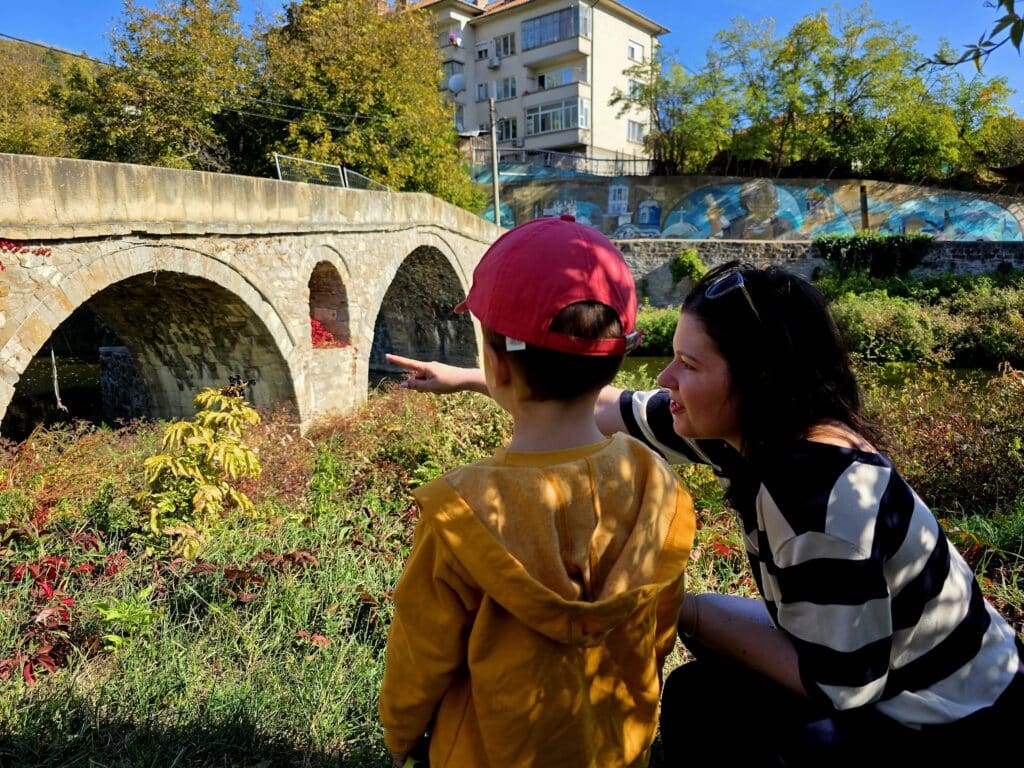
Just a five-minute walk from the museum rises the bridge over the Dryanovska River—the only bridge by Kolyu Ficheto to survive in its completely authentic form to this day. With its emblematic yoke-shaped silhouette, it passed its toughest historical test in 1877 during the Russo-Turkish War, when General Joseph Gurko’s heavy Russian artillery rolled across it without a hitch.

Today, centuries-old heritage meets contemporary urban culture here—talented graffiti artists have transformed the concrete retaining wall behind the bridge into a striking canvas of modern street art dedicated to the legendary Bulgarian master.

If you find yourself here in the late autumn afternoon, be sure to walk down to the riverbank—the old stone arches, framed by rust-colored trees and a light mist hovering over the water, turn the view into a true feast for the senses.
3. The Ikonomov House

Right next to the Clock Tower in the town center—and just a brisk 7–8 minute stroll from the bridge over the Dryanovska River—stands the imposing Ikonomov House. This true architectural masterpiece was crafted by Master Kolyu Ficheto in 1859 as a family home for the prominent local priest and chief churchwarden, Father Vasil Ikonomov.

Today, the building lives a new life as an art gallery. Its cozy rooms house an impressive collection of over 150 original icons, intricate woodcarvings, and authentic frescoes that instantly transport you into the spirit of the National Revival.
4. Holy Trinity Church and the Monastery School

Our next stop in Dryanovo takes us to the old Giley neighborhood, home to the oldest church in town—Holy Trinity Church, built in 1847. The moment you step across the threshold, you are greeted by an overwhelming sense of hospitality and homey warmth. Your gaze immediately glides across the carved wooden ceiling—a true work of art—while children’s drawings hanging on the walls and potted plants everywhere lend a special tenderness to the space.

When sunlight filters through the windows and falls upon the greenery, the atmosphere becomes almost fairy-tale-like. There, we were welcomed by the local priest, who gave us a brief yet deeply memorable talk on forgiveness—one of those genuine conversations that stays with you long after you leave.

Right next to the church, as if to complete the picture, sits the old Monastery School from the late 18th century—a modest room with sandboxes where future builders and merchants once traced their first letters and numbers. Stepping inside turned into a genuine blast for us. We traveled back in time, tried writing with real feather quills, and examined an antique abacus and globe.

What amused us most were the authentic wooden plaques that students once wore around their necks depending on their behavior and grades—labeled “diligent,” “tidy,” and even “class clown.”

Before you leave, be sure to peek into the church courtyard as well—it houses a woodcarving workshop where you can watch the craft in action and even take your first lessons.
5. The Lafchiev House

My absolute favorite landmark in Dryanovo is undoubtedly the Lafchiev House—a true Revival masterpiece carrying a palpable, almost gothic aesthetic and an extraordinarily cinematic presence.

It is not for nothing that locals call it “The House Without Nails”—when building it back in 1840, Master Kolyu Gaydardzhi did not use a single nail or metal bracket, pulling off a genuine architectural feat.

Inside, the house preserves the spirit of a bygone era with exquisitely arranged interiors, original furniture, household items, traditional clothing, and jewelry.

In wonderful contrast to this centuries-old tranquility, however, the house also lives a dynamic, modern life—one of its rooms now houses a podcast studio, while its spacious courtyard is one of the most picturesque spots in town, regularly hosting a wide variety of cultural events during the warmer months.

“Created by the Earth” Mineral Exhibition
Hidden in the ground floor of the Lafchiev House is Dryanovo’s newest pride—the jaw-dropping “Created by the Earth” mineral exhibition. It is a generous gift to the town from local resident Ventsislav Panev, who donated his impressive personal collection of over 270 rare specimens gathered from 80 different deposits.

The meticulous arrangement and play of light reveal the natural magic of the crystals in a way that boldly rivals major galleries in the capital, making a walk through this Revival house all the more unforgettable.
6. St. Nicholas Church – A View from Above

In the heart of Dryanovo (at 130 Shipka Street) rises St. Nicholas Church, built in 1851 by Master Kolyu Ficheto. Even from the outside, the church makes a powerful impression with its integrated bell tower and handsome facades—it is no coincidence that it has been declared a cultural monument of national significance. The atmosphere is heightened by the old cemetery right beside the church, which carries a distinct, almost Tim Burton-esque vibe and lends the place a slightly mystical air.

The real magic for us, however, was inside. The moment you cross the threshold, your eyes are naturally drawn to the smoothly curving balconies of the gallery (emporia). We were fortunate enough to climb upstairs, and the experience was truly one of a kind—up close, you can appreciate how beautifully and intricately they are painted, while the bird’s-eye view over the entire church and the priceless icons by Stanislav Dospevski is something you remember for a long time.

7. Dryanovo Monastery
End your day in the picturesque canyon just a few kilometers outside town, where, nestled among sheer limestone cliffs, rises the Dryanovo Monastery of St. Archangel Michael. Shrouded in autumn mist and fallen leaves, it looks like a true fortress out of a fairy tale—a place where centuries-old spirituality and heroic history literally merge with nature.

Founded back during the reign of Tsar Kaloyan following the translation of the relics of St. Michael the Warrior in 1206, the monastery served over the centuries as a safe haven for Bulgarian revolutionaries Vasil Levski and Matey Preobrazhenski (Mitkaloto).

Its most dramatic chapter, however, was written during the April Uprising of 1876, when 195 rebels led by Father Hariton and Bacho Kiro fought a doomed yet legendary nine-day battle against a multi-thousand-strong Ottoman army. The monastery was burned and half-destroyed, and the scars of that self-sacrifice remain visible to this day—cannonball holes from Ottoman artillery can still be seen embedded in the stone walls of the church.

8. Bacho Kiro Cave
Right behind the monastery, tucked into the sheer Boruna cliff face, awaits a true journey back to the very dawn of humanity—Bacho Kiro Cave. Nearly two million years ago, an ancient sea lapped against this spot, and later the waters of the Dryanovska River patiently carved a 3.6-kilometer labyrinth of whimsical karst galleries, stalactites, and ethereal stone draperies into the rock.

What makes this cave truly unique on a global scale, however, isn’t the rock formations above our heads, but what the earth preserved beneath our feet for millennia. Precision DNA testing and radiocarbon dating proved that the oldest confirmed remains of Homo sapiens in Europe (dating back 44,000 to 46,000 years) were discovered right here—a priceless time capsule from an era when early modern humans and Neanderthals still shared the same world.

Even more remarkably, these same galleries yielded Europe’s oldest known bone engraved with a geometric motif—a moving, first-of-its-kind testament to the birth of human art and abstract thought that turned this quiet Bulgarian gorge into a global scientific sensation.
